
Stand for Bangladeshi Folk Artists
In recent weeks, a disturbing pattern has emerged across Bangladesh: coordinated attacks, threats, and harassment targeting Bauls, mystic folk musicians, and other cultural workers. These are not “isolated incidents” or minor local disputes. They are, as two recent reports in Prothom Alo and The Daily Star (Bangla) make clear, a direct assault on the very soul of Bangladesh’s culture.
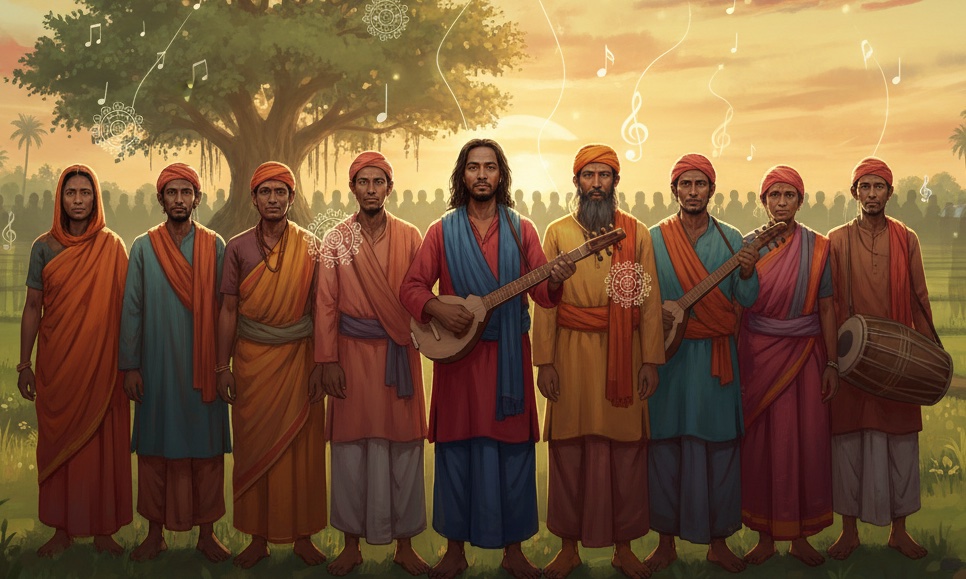
From Manikganj to Thakurgaon to Khulna, Baul artists and their followers have been beaten, chased, thrown into waterbodies while fleeing for their lives, humiliated, and criminalised under accusations of “hurting religious sentiment.” In Manikganj, Baul artist Abul Sarkar Maharaj has been arrested following a traditional philosophical musical debate — a palagan — where a few seconds of a four-hour performance were selectively clipped and circulated to manufacture outrage.
According to the Prothom Alo report, 40 writers, artists, teachers, musicians and rights activists from Chattogram have publicly warned that these attacks are not just on individuals but on Bangladesh’s “age-old culture, heritage, civic rights and the Constitution.” They see a clear pattern: extremist groups weaponising religious emotion, while the state mostly remains silent or even appears to enable them through inaction. This silence is not neutral. It emboldens the attackers and deepens the fear among cultural workers.
The Daily Star’s coverage adds important context. It shows that:
- The attacks are being led by groups presenting themselves as “tawhidi janata,” claiming religious legitimacy while using mob violence and threats.
- The controversy stems from a historic palagan tradition — “Jib o Porom Pala” — which is over a century old. This is a form of philosophical discourse in song, where two sides (e.g. jib vs porom, shariah vs marfat, Hindu vs Muslim, etc.) debate ideas through metaphor and poetry.
- As playwright and lyricist Shakir Dewan explains, these songs are not meant to insult faith; they are a form of spiritual and philosophical reflection. Audiences have long embraced them as part of their devotional and cultural life.
- Thinker Farhad Mazhar points out that taking a few seconds from hours of performance to accuse someone of “blasphemy” is an explicitly political act. It is about controlling ideas, not protecting religion.
- Theatre personality Syed Jamil Ahmed reminds us that many people in Bangladesh find their life philosophy through Baul songs. To attack Bauls is to attack people’s inner spiritual and emotional world.
These reports together show three crucial truths:
-
This is a cultural and political attack, not a religious necessity.
Bauls, mystic singers, and folk performers have long sung about love, equality, humanity, and inner spirituality. They are not attempting to destroy faith; they are expanding its meaning in people’s hearts. Branding them as “enemies” serves a political project of fear and control. -
Silence from institutions is dangerous.
When police stand by during attacks, when artists are arrested instead of protected, when extremists face no consequences, it signals that cultural freedom is negotiable — that mobs can dictate what can be sung, said, or thought. That contradicts Bangladesh’s constitutional values and its proud history of cultural resistance. -
Attacking folk artists is attacking Bangladesh itself.
Baul songs, palagan, marfati and mursidi songs are not fringe curiosities. They are core threads in the fabric of Bengali identity. From Lalon to the countless unnamed village singers, these traditions have carried ideas of equality, spiritual freedom, and human dignity through generations. Erasing them means shrinking the space for diversity, creativity, and humane values in society.
If we allow Bauls and folk artists to be silenced today, tomorrow it will be theatre groups, painters, writers, journalists, anyone who dares to imagine a freer, more humane Bangladesh.
So what does it mean to stand for Bangladeshi folk artists right now?
-
Speak up, publicly and clearly.
Use your voice — on social media, in institutions, in your community — to reject violence against Bauls and other cultural workers, and to demand protection for them. -
Insist on rule of law, not rule of mobs.
Call for impartial investigations, prosecution of attackers, and the immediate end of using vague “religious insult” claims to criminalise artists. Abul Sarkar Maharaj and others targeted in this campaign must receive justice, not persecution. -
Support the culture you want to save.
Listen to Baul and folk music. Share their songs. Invite them to perform. Help document and archive their work. Cultural solidarity is not only political; it is also practical and everyday. -
Refuse the false choice between faith and culture.
As many of the voices in these reports note, song and spirituality have long gone hand in hand in Bengal. We do not have to choose between religion and music, faith and freedom. Those presenting this as a war are serving their own agenda, not the public good.
Bangladesh was not built on fear of songs. It was built, again and again, on the courage of people who sang, wrote, and spoke truth in the face of repression.
Standing for Bangladeshi folk artists today is not a niche cause. It is a stand for a plural, humane, democratic Bangladesh — where no one is thrown into a pond or into prison for singing about life, love, and the search for the divine.
Now is the time to choose a side.
Stand with the Bauls. Stand with the folk artists. Stand with the culture that made us.
You don’t see that they insulted our religion 1st. Remember which side you are taking, there price for it that you need to pay. You think you are out of reach remember we have link all over the world.
Well, on that case you should report to the police, not physically attack them. Wake up and educate yourself.
They deserved instant punishments not the red tape. You deserve too for taking their side.
বিদেশে বসে ধর্ম অবমাননা কারীর পক্ষ নেও, তোমাকে সাইজ করা কঠিন কিছু না, ২ দিন পরই দেখবা