
Shadow Over Victory: Violence Targets Minorities and Political Rivals Following Bangladesh’s Historic Election
Date: February 17, 2026 Location: Dhaka, Bangladesh
DHAKA – Less than a week after Bangladeshis turned out in record numbers for the historic February 12 general election, the celebratory mood has been darkened by a wave of retribution and violence. While the Bangladesh Nationalist Party (BNP) secured a landslide victory, ending the interim period that followed the 2024 ouster of Sheikh Hasina, reports are flooding in from across the country detailing systematic attacks on political opponents and religious minorities.
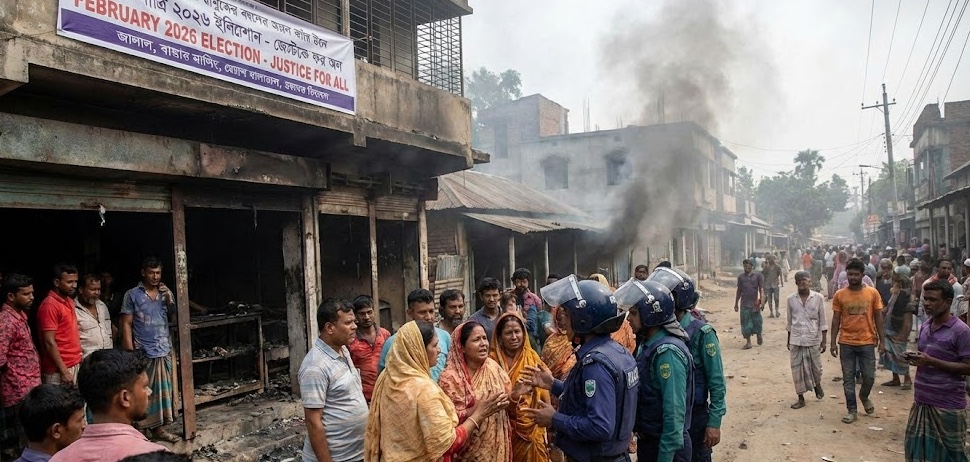
The election, intended to mark a return to democratic stability under the watchful eye of the interim government, has instead opened old wounds. As the results solidified a two-thirds majority for the BNP-led coalition, incidents of arson, looting, and intimidation have surged in several districts, raising alarm among human rights organizations and the international community.
Minorities in the Crosshairs
The most harrowing reports concern Bangladesh’s religious minorities, particularly the Hindu community, who have historically been vulnerable during periods of political transition. In the days following the vote, minority rights groups have documented attacks on homes, temples, and businesses in districts such as Jessore, Dinajpur, and parts of Chittagong.
“We voted with hope for a new beginning, but now we are sleeping in shifts, fearing the mob,” said a resident of a minority-majority village in Rangpur, speaking on condition of anonymity.
Local observers point to rising “anti-India rhetoric” during the campaign season as a catalyst. With the ousted Awami League often accused by its rivals of being too close to New Delhi, anger against the former regime has tragically spilled over onto Hindu citizens, who are frequently perceived as part of the Awami League’s vote bank—even in an election where the party was banned from participating.
Political “Cleaning” and Retribution
The violence has not been limited to religious lines. Grassroots activists and known sympathizers of the banned Awami League have also faced severe reprisals. Despite the BNP leadership’s pre-election promises of “clean politics” and an end to the cycle of vengeance, local cadres in rural areas appear to be engaging in “territorial reclamation.”
Reports indicate that community centers and homes belonging to former ruling party members have been vandalized. In some areas, clashes have erupted between jubilant BNP supporters and activists from the Jamaat-e-Islami, the country’s largest Islamist party which secured the second-highest number of seats, as they vie for local dominance in the new political order.
Calls for Calm Amidst the Chaos
The scale of the unrest has prompted urgent calls for action. Civil society leaders and student coordinators from the 2024 “Monsoon Revolution”—who played a pivotal role in toppling the previous autocracy—have condemned the attacks, labeling them a betrayal of the democratic aspirations of the youth.
“This is not the Bangladesh we fought for in the streets,” said a prominent student leader in a press statement yesterday. “Replacing one form of tyranny with mob rule is a failure of our revolution. The new government must ensure the safety of every citizen, regardless of their faith or past political affiliation.”
Tarique Rahman, the BNP leader whose party is set to form the government, has issued a statement urging supporters to show restraint and warning that those inciting violence will face legal consequences. However, critics argue that the message is struggling to reach the grassroots level, where the vacuum of power is being filled by force.
International Concern
The international community is watching closely. The United Nations and human rights watchdogs have urged the incoming administration to prioritize the protection of vulnerable groups. Meanwhile, diplomatic tensions are simmering, with neighboring India expressing “grave concern” over the safety of minorities and the volatile security situation on its borders.
As Bangladesh prepares for the official transfer of power, the challenge for the incoming government is stark: it must move quickly to halt the violence and prove that the 2026 election was truly a step toward democracy, rather than a prelude to a new cycle of instability.
Key Facts at a Glance:
-
Election Date: February 12, 2026
-
Result: BNP Landslide Victory (approx. 212 seats); Jamaat-e-Islami (approx. 77 seats).
-
Primary Targets of Violence: Religious minorities (Hindus) and former Awami League affiliates.
-
Key Issues: Post-election reprisals, breakdown of local law and order, anti-India sentiment fueling communal tension.